A World Without Project
On Monday I finished the first playable iteration of the game: upon completing 5 levels, the player wins and is sent to the victory menu which either returns them to the main menu or exits the game. This can be refined later with an appealing redesign and a story ending that reflects my research.
On Tuesday a friend helped me with ideas to redesign the settings menu to look very solid compared to the rest of the game. All the assets were made by me in paint.net, and every button has a highlight when hovered to ensure UX is solid. All the clickable buttons including apple and go back have 2 states – highlighted and dark – which get swapped between in the menu widget. The fonts are Bubble Man and Wakaba Regular.

On Wednesday I went into university and Will helped me remove the spaghetti code by replacing the 5 separate code sections with one switch on string related to the level name. This makes the code far easier to digest.

On Friday I added a player hp variable and made 1/10 of the fodder spawn as enemies by adding a random integer selection. I linked this value to a player hp bar by setting the fill image bright and the default image dark – similar to the settings menu.
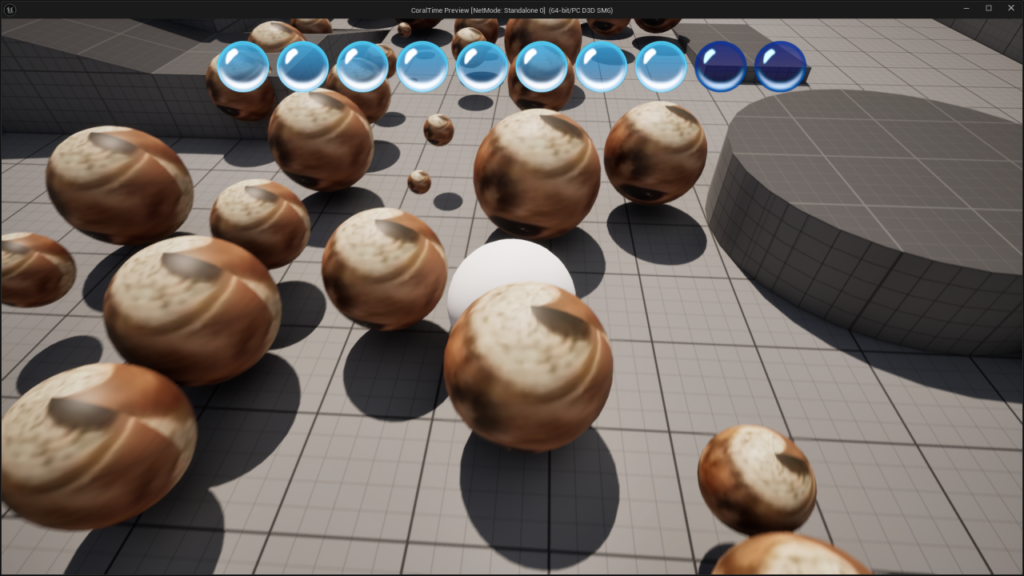
The next steps will be to shade the fodder green and the enemy fodder red, presumably with basic material instances. I also intend to show the player’s size goal somewhere on the screen so that there’s a clear indication of the gameplay loop outside the controls menu.
Game Research
Now that I’m planning to add graphics, I intend to utilise my research to decide how to design the world, player and enemies. I had researched some basics on coral formation before but did not write it down so I’ll include it for personal reference below. Analysis of the information relative to my game is included below the italics.
Coral reefs begin to form when free-swimming coral larvae attach to submerged rocks or other hard surfaces along the edges of islands or continents. As the corals grow and expand, reefs take on one of three major characteristic structures—fringing, barrier, or atoll. Fringing reefs, which are the most common, project seaward directly from the shore, forming borders along the shoreline and surrounding islands. Barrier reefs also border shorelines, but at a greater distance. They are separated from their adjacent land mass by a lagoon of open, often deep water. If a fringing reef forms around a volcanic island that sinks completely below sea level while the coral continues to grow upward, an atoll forms. Atolls are usually circular or oval, with a central lagoon. Parts of the reef platform may emerge as one or more islands, and gaps in the reef provide access to the central lagoon.
In addition to being some of the most beautiful and biologically diverse habitats in the ocean, barrier reefs and atolls also are some of the oldest. With growth rates of 0.3 to 2 centimeters per year for massive corals, and up to 10 centimeters per year for branching corals, it can take up to 10,000 years for a coral reef to form. Depending on their size, barrier reefs and atolls can take from 100,000 to 30 million years to fully form.

All three reef types — fringing, barrier, and atoll — share similarities in their biogeographic profiles. The structure and makeup of the ocean floor in each reef zone, as well as depth, wave and current strength, light, temperature, and suspended sediments all act to create characteristic horizontal and vertical zones of corals, algae, and other species. These zones vary according to the location and type of reef. The major divisions common to most reefs, as they move seaward from the shore, are the reef flat, reef crest or algal ridge, buttress zone, and seaward slope.
This information shaped the basic idea for my game. I was originally planning something like Subnautica resource gathering with the radar scanner where you collect materials and bring them back to the reef to grow it, but that sounded pretty bland to play. The katamari-like system of the current idea can effectively represent the growth of coral reefs in a much shorter timescale, showing 5 “growth stages”, the relevant ideas and challenges that the coral may face while being formed.
The player represents the coral larvae that attach to rocks and other objects, which will be the primary game setting. In later levels the formation of fringings, barriers or atolls could be explored, alongside the structure depicted in the above image. The enemies lean more into the gamification of the idea; coral would likely not be directly attacked by predators but it’s an easy way to depict imminent danger to the player.
Research Project
After careful deliberation based on preliminary research and the direction my info was taking, I have chosen the temporary title “Evaluating the modernisation of arcades: The ticket to success” for the technical report. I was hesitant to pick a title that strongly suggested a point (Player control vs profit) as it may add bias to my hypothesis; viewing modernisation through the lens of moving from retro games driven by high scores and social standing to modern ticket systems and playing for prizes allows me to evenly evaluate all perspectives and provide insight into the benefits and flaws of each system.
The hypothesis is “whether higher player control within arcade games correlates to a higher popularity of these games and of the arcade containing them”. This can be tested through analysis of statistics of retro arcades and modern arcades in various regions that utilise different types of games. I intend to discuss the golden age of arcade games spurred on by retro games, moving into the era where ticket prizes were required to compete with home consoles and finally modern games that attempt to offer unique experiences – perhaps this is where the rhythm game case study can fit in.
My motivation is still seriously lacking – as of writing this on Saturday I haven’t got any serious information typed out yet and I definitely didn’t effectively stick to my time plan. I took some time to ensure my plans felt solid and I have a lot to write about the information above, so I should still have plenty of time to crunch essay writing this week and have two weeks to expand on my research and refine the writing.